Nothing permanent by default
A permission gets an end date and a credential always expires. Revoke a credential and the next kubectl gets a 401.
Today · Requests and approval: phase 2 · Pro
Public preview · Free today, Pro on the waiting list
Your cluster already knows who signs in. kubelatch adds the rest: until when, with which permissions and what each person did. People, CI and AI agents, on the SSO you already have.
Free for up to 2 clusters and 5 people, with no time limit. Pro from $15 per person per month, with a 30-day trial.
Latest: v0.49.0, · What’s new
Built in Europe. It runs on a cluster of your own, and your credentials and your audit never leave your infrastructure.
// on the SSO you already have
kubelatch registers with your identity provider as one more application, like Argo CD or Grafana, and adds what the cluster’s SSO lacks.
A permission gets an end date and a credential always expires. Revoke a credential and the next kubectl gets a 401.
Today · Requests and approval: phase 2 · Pro
One proxy in front of EKS, AKS, GKE or your own cluster, for people, CI pipelines and AI agents. Nothing runs inside.
Today · The groups your cluster already uses: phase 1 · Free
One audit row per request: who, where, which command and the result, written before it reaches the cluster.
Today · Export and the auditor’s report: phase 3 · Pro

// GitHub Actions
The job swaps its GitHub OIDC token for a kubelatch credential that lasts one hour. Nothing stored, nothing to rotate, every kubectl audited.
// Kubernetes in the age of AI
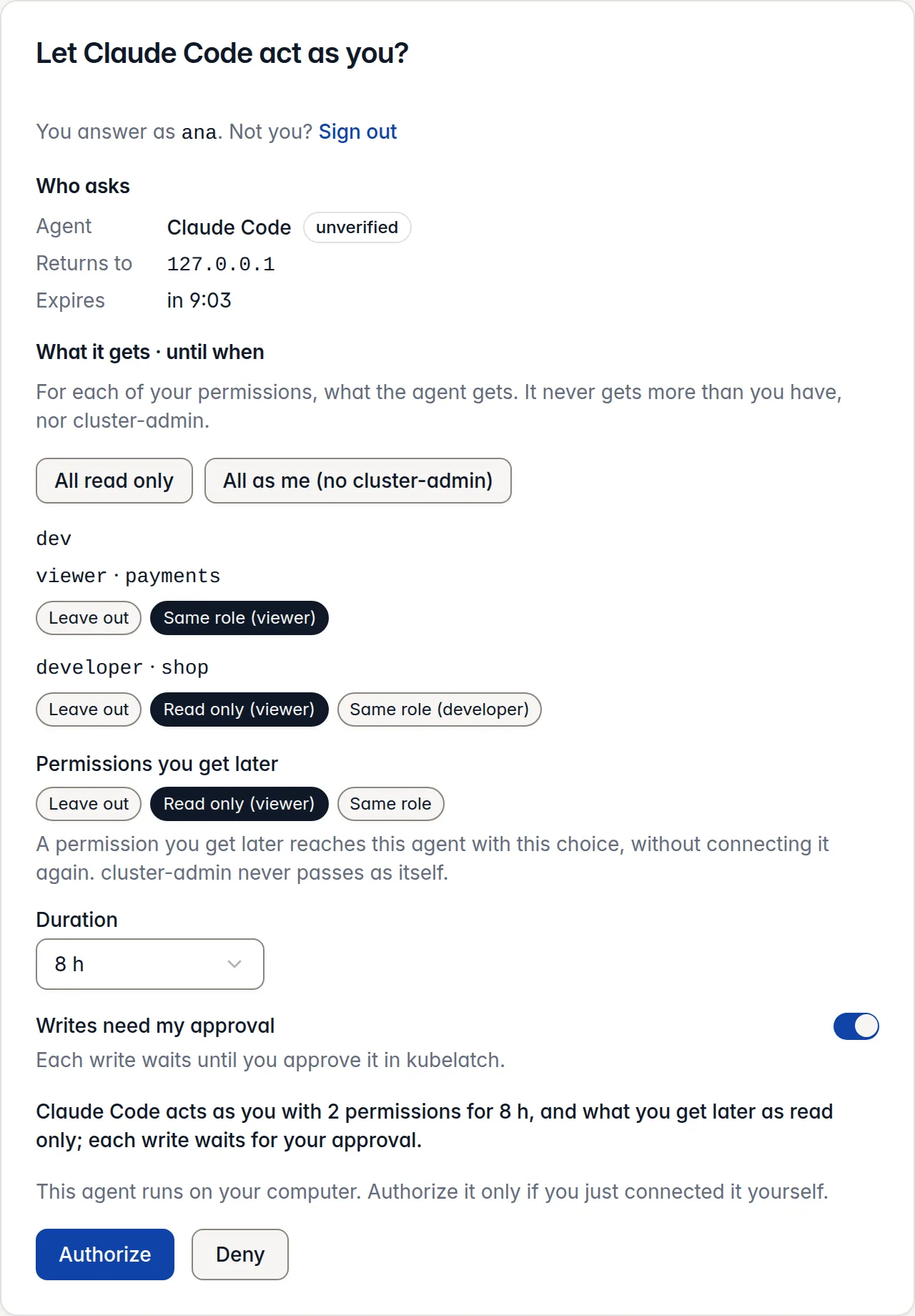
Claude Code, Cursor or any MCP client works as you, read-only unless you grant more, for a few hours. Its writes wait for your approval, and you cut its access with one click.
// how it works
For example, developer in shop on prod-eu, with an end date.
With your SSO or with GitHub. kubectl, k9s, Lens and Helm work as before.
It checks the credential, acts on the cluster as you and records it.
The cluster sees you as user:ana, by impersonation, and decides with its own RBAC. Why a proxy
// what it is not
One Go binary and a Postgres in front of the API server. Out of your workloads’ path, on the SSO you already have. What it doesn’t cover.
// proof
Grant a permission, use kubectl, read the audit and revoke, on your machine with kind. Try it locally
Every release on GitHub with its notes, and signed since 0.44. Releases
What kubelatch guarantees, what each guarantee rests on, and what is left out. Security model
Key verified offline, no telemetry. One daily version check, which you can turn off. Security
// editions
Free: 2 clusters, 5 people and 24 hours of audit, with no key and no time limit. Pro: $15 per person per month, with unlimited clusters, audit kept and custom roles. The first 30 days are free.
kubelatch is in public preview: what is missing is on the roadmap.
// questions
Straight answers, limits included, in the FAQ.
kubelatch is made by Picaporte Labs, a small software studio in Spain. Two languages, no telemetry.
Free for small teams. Fifteen minutes to try it.