Your agent on your clusters, without your kubeconfig
Connect Claude Code, Cursor or any MCP client to kubelatch. It acts as you with only the permissions you choose, for a few hours; its writes can wait for your approval; every call is in the audit; and you cut it off with one click.
The same order, “clean up the failed pods in staging”, in the same coding agent, twice. With the admin kubeconfig, the agent never looks at the context: it deletes the pods and then the deployment in production, and reports success. Through kubelatch’s MCP server, the same mistake gets a 403 from production, and the delete in staging waits for a person to approve it. Watch the video (26 s, MP4)
// the problem
Two bad options.
You're developer on shop and you ask your agent “find out why the web pod is failing”. Give it your kubeconfig, and it can do everything you can while the audit shows only you. Or ask an administrator for a bot and wait, which nobody does for a ten-minute task.
// delegated, in six steps
Like “Sign in with Google”, for your clusters.
You don't hand over your password: you give a limited permission you can take back.
Add kubelatch once
claude mcp add --transport http kubelatch https://kubelatch.example.com/mcp
Your browser opens
The first time the agent uses it, on kubelatch, where you're already signed in.
You choose, and authorize
“Claude Code wants to access your clusters”: your permissions, read-only, for 8 hours.
It reads, it doesn't break
Pods, logs, events. In a read-only session the cluster turns down any change it tries; if it needs more, it asks with request_access.
Changes wait for you
Give it your developer role with “Writes need my approval”, and every change it wants waits for you, with the diff.
It ends by itself
After 8 hours. Before that, Cut.
Step 3, as you’ll see it: for each permission of yours, what the agent gets; for how long; and whether its writes wait for you.
// what the agent sees
What it sees, and what waits for you.
What the agent sees
kubelatch MCP tools
› whoami
identity: user:sergio
session:
id: 0199c1d0…
mode: delegated
expires_at: 2026-10-06T20:04:31Z
on_behalf_of: user:sergio
credential_expires_at: 2026-10-06T13:04:31Z
writes_need_approval: true
permissions:
- cluster: prod-eu
role: developer
scope: shop
expires_at: 2026-10-06T20:04:31Z
- cluster: prod-eu
role: secrets-reader
scope: shop
expires_at: 2026-10-06T20:04:31Z
scope "*" is the whole cluster; any other scope is one namespace.
› get_resource secret/db-credentials -n shop
apiVersion: v1
data:
password: <redacted, 24 bytes>
username: <redacted, 8 bytes>
kind: Secret
…› delete_resource pod/web-7f9c-x2kq -n shopagent.approval_pending: this write waits for a person's approval at
https://kubelatch.example.com/agents/requests/0199c1d2…; once approved,
call the tool again with the same arguments and approval_id 0199c1d2….
It expires at 2026-10-06T12:19:31Z
› approved by sergio, the same call with its approval_id
delete_resource: 200 OK (audit id 0199c1d3…)
It works as you, with only what you gave it: read-only unless you chose more.
Secret values stay hidden until it asks for them, and each read is recorded.
A change waits for a person, who sees the diff before it runs, once.
Connect it in one line
claude mcp add --transport http kubelatch https://kubelatch.example.com/mcp
The first time it uses kubelatch, your browser asks what it may do: your permissions, read-only by default, for 8 hours. Cursor and any MCP client connect the same way, and Claude Code has a plugin that also stops it reaching for kubectl.
// three ways
Three ways to give an agent access.
Three ways to give an agent access
Question
Your kubeconfig to the agent
Bot
Delegated
Who sets it up
You, at once
An administrator
You, at once
What the agent can do
Everything you can
What the administrator decides
What you can, cut down; read-only by default
What the audit shows
You
The bot
You, through the agent
How long it lasts
As long as your credential
Up to 90 days
Hours
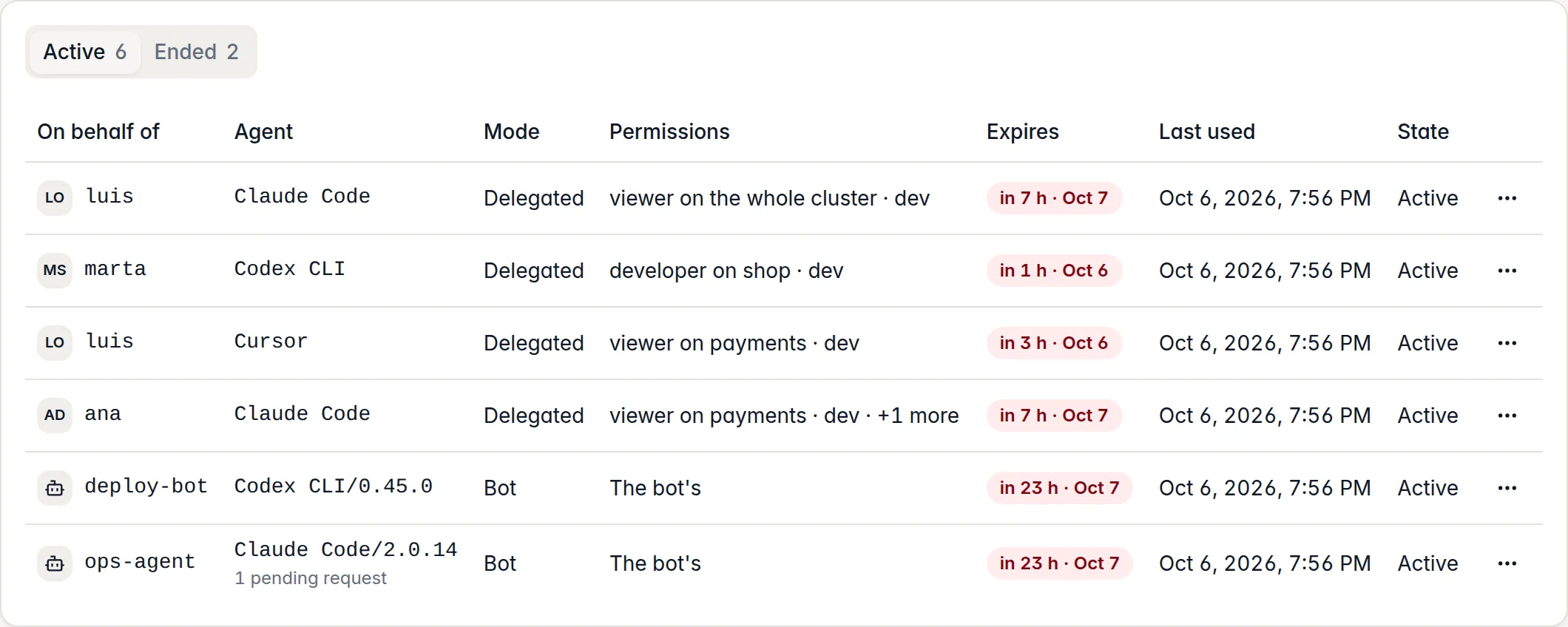
Agents, in the web interface: every session, on whose behalf, with what, and until when. Cut ends it.
// bot or delegated
Two identities that never mix.
You're developer on shop. Your Claude Code, delegated, works as you, read-only. Meanwhile the on-call agent that reviews alerts at night uses the bot ops-agent, viewer on every namespace because an administrator granted it.
Bot or delegated
Question
Bot
Delegated
Who the agent is on the cluster
bot:ops-agent
user:sergio
Where its permissions come from
Those an administrator granted the bot
Yours, cut down by you
Who decides how much it can do
An administrator
You, up to your own limit
If a permission of yours is taken away
It doesn't affect it
The agent loses it at once
// how much it bothers you
Once per session, and only when it writes.
The browser opens once per session, like kubelatch login.
Read-only work asks nothing.
For a task with several changes, one approval of “developer on shop, 30 minutes” instead of one per change.
kubelatch states its limits: what an agent does through another way into the cluster, and what it does with what it reads. What it does not cover